

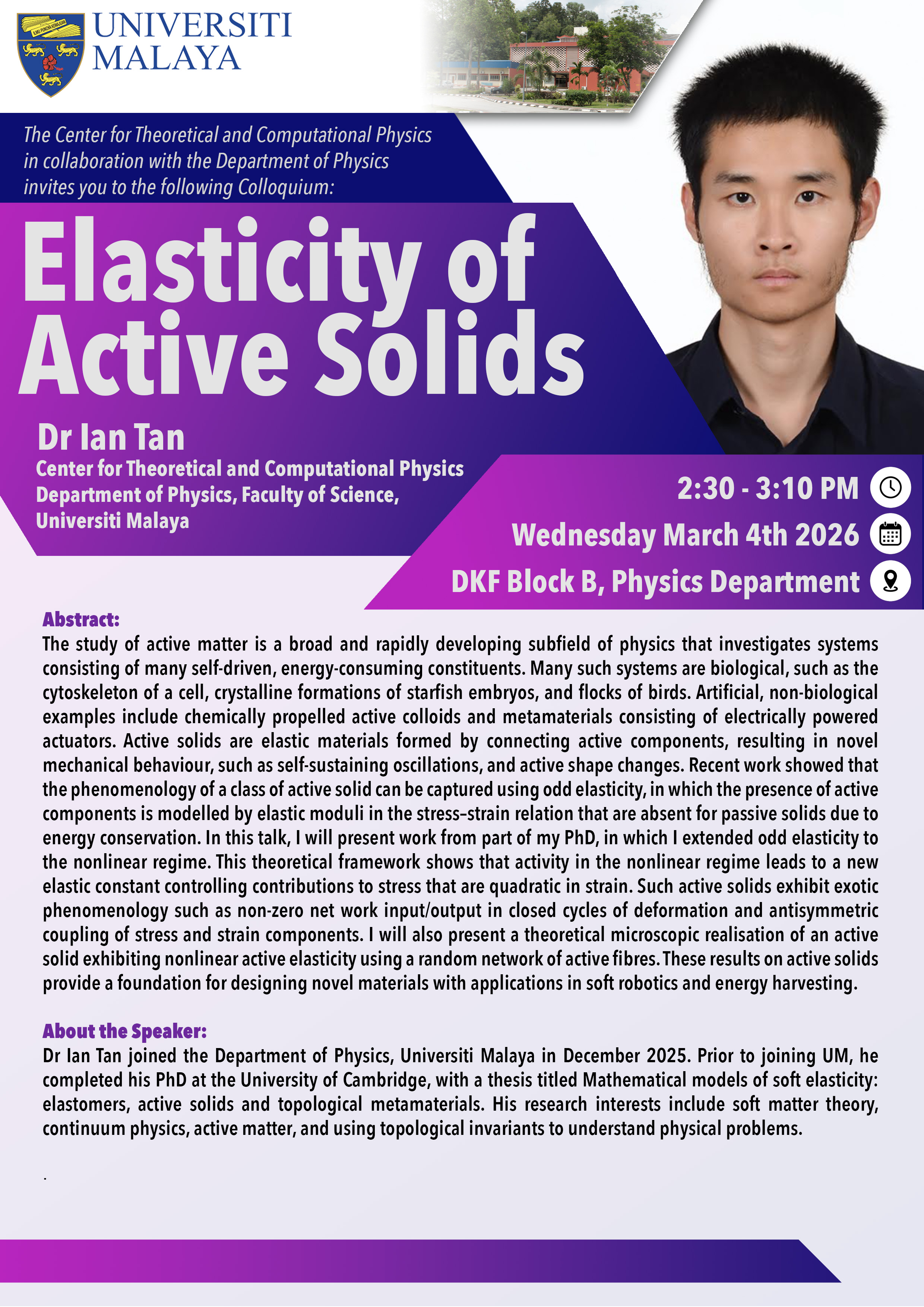
Talk 1: Elasticity of Active Solids
2:30 - 3:10 PM, Wednesday March 4th 2026
DKF Block B, Physics Department
Dr Ian Tan
Center for Theoretical and Computational Physics, Department of Physics, Faculty of Science, Universiti Malaya
Abstract:
The study of active matter is a broad and rapidly developing subfield of physics that investigates systems consisting of many self-driven, energy-consuming constituents. Many such systems are biological, such as the cytoskeleton of a cell, crystalline formations of starfish embryos, and flocks of birds. Artificial, non-biological examples include chemically propelled active colloids and metamaterials consisting of electrically powered actuators. Active solids are elastic materials formed by connecting active components, resulting in novel mechanical behaviour, such as self-sustaining oscillations, and active shape changes. Recent work showed that the phenomenology of a class of active solid can be captured using odd elasticity, in which the presence of active components is modelled by elastic moduli in the stress–strain relation that are absent for passive solids due to energy conservation. In this talk, I will present work from part of my PhD, in which I extended odd elasticity to the nonlinear regime. This theoretical framework shows that activity in the nonlinear regime leads to a new elastic constant controlling contributions to stress that are quadratic in strain. Such active solids exhibit exotic phenomenology such as non-zero net work input/output in closed cycles of deformation and antisymmetric coupling of stress and strain components. I will also present a theoretical microscopic realisation of an active solid exhibiting nonlinear active elasticity using a random network of active fibres. These results on active solids provide a foundation for designing novel materials with applications in soft robotics and energy harvesting.
Bibliography:
Dr Ian Tan joined the Department of Physics, Universiti Malaya in December 2025. Prior to joining UM, he completed his PhD at the University of Cambridge, with a thesis titled Mathematical models of soft elasticity: elastomers, active solids and topological metamaterials. His research interests include soft matter theory, continuum physics, active matter, and using topological invariants to understand physical problems.
Thank you.