Greetings,
The Physics Department invites you to the following colloquium:
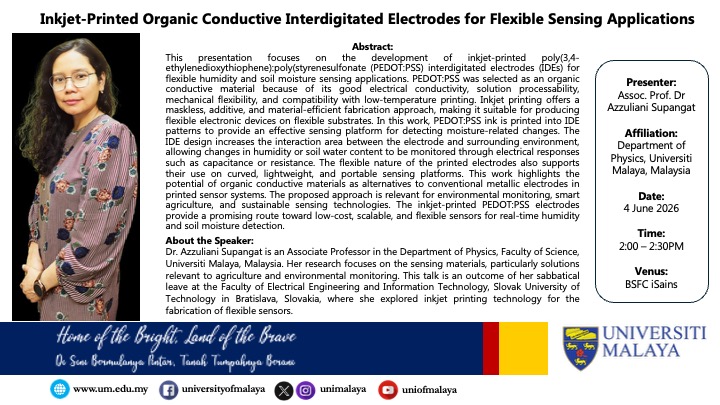
Inkjet-Printed Organic Conductive Interdigitated Electrodes for Flexible Sensing Applications
Presenter: Assoc. Prof. Dr Azzuliani Supangat
Affiliation: Department of Physics, Universiti Malaya, Malaysia
Date: 4 June 2026
Time: 2:00 – 2:30PM
Venus: BSFC iSains
Abstract:
This presentation focuses on the development of inkjet-printed poly(3,4-ethylenedioxythiophene):poly(styrenesulfonate (PEDOT:PSS) interdigitated electrodes (IDEs) for flexible humidity and soil moisture sensing applications. PEDOT:PSS was selected as an organic conductive material because of its good electrical conductivity, solution processability, mechanical flexibility, and compatibility with low-temperature printing. Inkjet printing offers a maskless, additive, and material-efficient fabrication approach, making it suitable for producing flexible electronic devices on flexible substrates. In this work, PEDOT:PSS ink is printed into IDE patterns to provide an effective sensing platform for detecting moisture-related changes. The IDE design increases the interaction area between the electrode and surrounding environment, allowing changes in humidity or soil water content to be monitored through electrical responses such as capacitance or resistance. The flexible nature of the printed electrodes also supports their use on curved, lightweight, and portable sensing platforms. This work highlights the potential of organic conductive materials as alternatives to conventional metallic electrodes in printed sensor systems. The proposed approach is relevant for environmental monitoring, smart agriculture, and sustainable sensing technologies. The inkjet-printed PEDOT:PSS electrodes provide a promising route toward low-cost, scalable, and flexible sensors for real-time humidity and soil moisture detection.
About the Speaker:
Dr. Azzuliani Supangat is an Associate Professor in the Department of Physics, Faculty of Science, Universiti Malaya, Malaysia. Her research focuses on the sensing materials, particularly solutions relevant to agriculture and environmental monitoring. This talk is an outcome of her sabbatical leave at the Faculty of Electrical Engineering and Information Technology, Slovak University of Technology in Bratislava, Slovakia, where she explored inkjet printing technology for the fabrication of flexible sensors.
Thank you.